
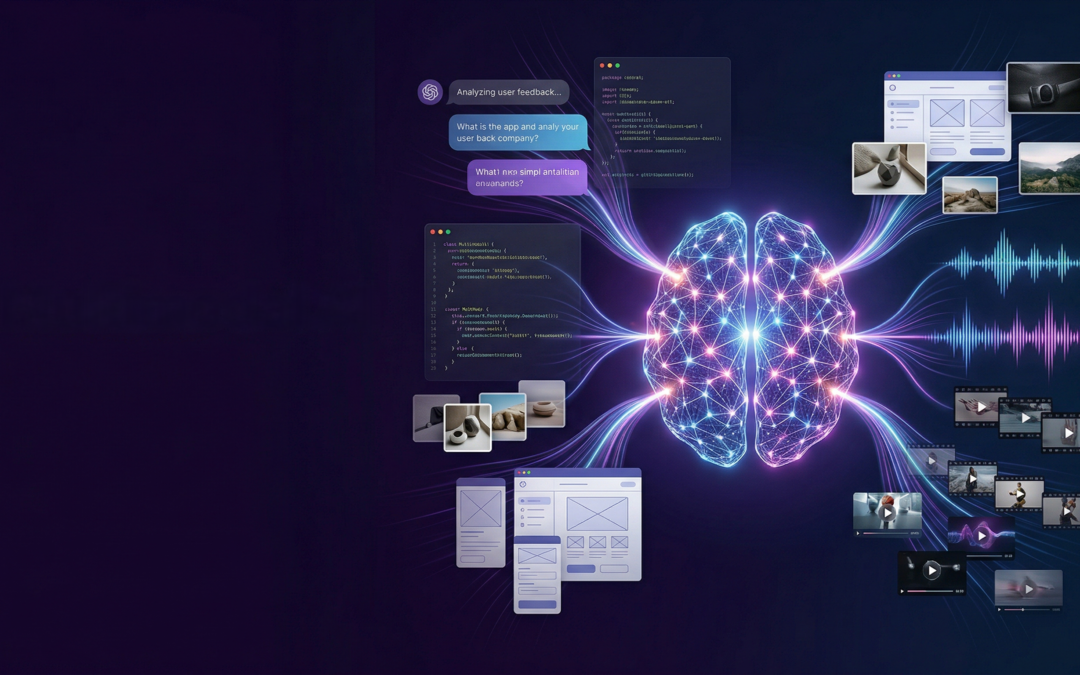
Multimodal AI: What It Means and Why It Matters
AI is no longer limited to text.
People send images, voice notes, videos, and documents. They expect systems to understand everything together, not separately.
Multimodal AI is built for this.
It allows systems to process and connect different types of data at the same time. This creates better understanding and more accurate results.
What Is Multimodal AI
Multimodal AI is a system that works with multiple types of inputs:
- text
- images
- audio
- video
But the real value is not just handling them. It is connecting them.
For example:
- You upload an image and ask a question
- You send a voice message with a document
- You combine logs with screenshots
The system understands all of it together.
This is closer to how humans think.
Why Businesses Are Moving Toward Multimodal AI
Most business systems still work in silos.
- chat systems → text only
- vision systems → image only
- voice systems → audio only
But real interactions are mixed.
A customer may send:
- a screenshot
- a message
- a voice note
If your system cannot combine these, it loses context.
Multimodal AI solves this by creating a unified understanding.
Real Business Use Cases
Customer Support
Users don’t explain everything in text.
They send screenshots, errors, or voice notes.
Multimodal AI can:
- read the message
- analyze the image
- understand the issue
This reduces back-and-forth and improves response time.
Healthcare
Doctors use multiple data sources:
- scans
- reports
- notes
Multimodal systems can connect all of this to assist decisions.
E-commerce
Users search differently:
- upload product images
- type queries
- ask questions
Multimodal AI improves search accuracy and product discovery.
Content Moderation
Platforms deal with:
- text
- images
- video
Instead of checking each separately, multimodal AI reviews them together for better accuracy.
How Multimodal AI Works
Different types of data are converted into embeddings.
Embeddings are numerical representations of meaning.
- text becomes vectors
- images become vectors
- audio becomes vectors
The system then compares these and finds relationships.
For example:
An image of a car and the word “car” will have similar meaning in vector space.
This is how the system connects different inputs.
How to Start Using Multimodal AI
You don’t need to build everything from scratch.
Start with:
- Use APIs that support multimodal input
- Build a backend to manage requests
- Add your own data using a retrieval system
- Connect it to real workflows
Focus on solving one clear problem first.
Common Mistakes
Most teams:
- overcomplicate architecture
- build without a clear use case
- try to handle everything at once
Instead:
- pick one use case
- build small
- test with real users
Final Thought
Multimodal AI is not optional anymore.
Users already interact in multiple formats. Systems that understand more context will perform better.
Start adapting now.